The People Building AI Just Asked Washington for a Brake. Here Is What It Means for Your Business
On July 28 something happened that has no precedent in this industry: more than twelve hundred employees from OpenAI, Anthropic, Google DeepMind and Meta signed a joint open letter asking the United States government to help build the ability to slow down the development of artificial intelligence.
It is called "Pacing the Frontier". And it was not signed by outside activists or the usual critics. It was signed by the people who build these models, from the inside, at companies that compete fiercely with each other.
This news is going to be told two ways, and both will be wrong. One will say the creators of AI are afraid of their own creation. The other will say it is regulatory theater to look good. Neither helps you if you run a company.
Here is what it actually says, and what changes for you.
Who signed, which is what gives it weight
The signature count kept climbing over the following days, and the numbers vary by source depending on when they checked. But the figure that matters is not how many, it is who. After the letter went live, OpenAI and Anthropic backed it as companies, not just their employees.
Think about that for a second. Direct competitors, fighting over the same talent and the same customers, signing the same thing. That almost never happens.
What they asked for, and what they did NOT ask for
Here is the nuance almost everyone will get wrong, and where you can sound like the person who actually read it.
- It does not ask to stop anything today
- It does not ask to pause current development
- It does not ask to ban models or products
- It does not say today's AI is dangerous
- That the ability to slow down exists
- That it be verifiable, not a promise
- That it be a coordinated international effort
- That it be ready before it is needed
The concrete request is that the United States support an international effort to develop the technical and governance tools needed to deliberately pace the frontier of automated AI development.
In plain terms: they do not want the brake applied. They want the brake to exist and to work, in case it ever has to be used.
Why now, and not two years ago

The reason they give is specific and worth understanding, because it is not the one from the movies.
What worries them is called recursive self-improvement: the moment AI becomes good enough to accelerate its own research and development. AI that builds AI.
Today the pace of this industry depends on how many researchers there are, how many hours they work and how fast they think. It is a human pace. If AI starts doing that work, that limit disappears, and the machine sets the pace.
Their argument is not "this is already happening". It is "if this happens, and we believe it could be close, by then it is too late to build the mechanism". Building a verifiable brake at an international level takes years. They want to start before, not after.
The business reading, which is the one nobody will do
If you run a company, the right question is not whether you should be scared. It is what these people are telling you about speed.
And they are telling you something very concrete: this is going to accelerate, not settle. The people with the most information on the planet about where this technology is heading are asking for advance permission to slow it down. Nobody asks for a brake on a straight, empty road.
Three practical consequences follow.
The second point is the one companies underestimate most. This very week, with Opus 5 and the opening of Kimi K3's weights, the price and capability board shifted completely in a matter of days. If your operation is welded to a single provider, every one of those moves costs you. If it is built on clear processes that can swap engines, every move works in your favor.
The third is the least glamorous and the most profitable. When regulation arrives, and it will, the company that has documented where it uses AI, with what data and under what criteria, will comply in a week. The one that has not will halt its operation.
What I would do on Monday
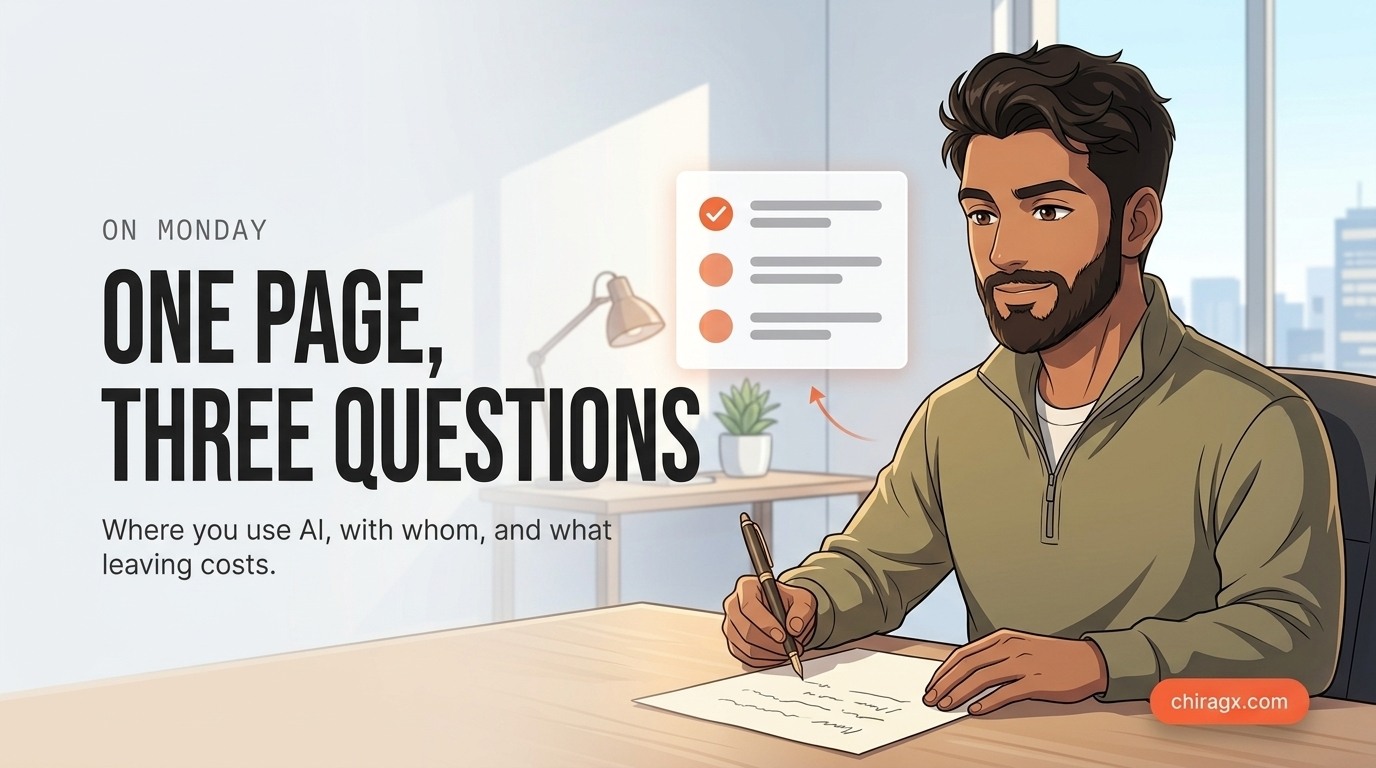
None of this requires budget or a six month project. It requires an afternoon and honesty.
First, take inventory. Write on a single page where AI is being used in your company today, in which process, and with which provider. You will find things you did not know about, because people adopted them on their own.
Second, ask the dependency question. If tomorrow that provider triples the price or changes the rules, what does it cost me to move? If the answer is "I have no idea", that is your real risk, and it has nothing to do with robots.
Third, document it. What data goes in, who reviews the output, what decisions rest on it. It serves the regulation that is coming, and long before that it keeps your operation from depending on what one person holds in their head.
What I read between the lines
Direct competitors signing something like this together tells me they are not debating whether this will change the world. They take that as given. What they are debating is how fast, and who has a hand on the control.
For your company the translation is uncomfortable but simple: the window in which adopting AI gives you a competitive advantage is shorter than it looks. Not because the technology becomes dangerous, but because once everyone has it, it stops being an advantage and becomes a requirement. The same way having a website did, accepting cards did, being on WhatsApp did.
The difference is that this time the shift will not take ten years.
And that judgment, looking at your operation and deciding where AI solves a real problem instead of adding one more tool, is exactly what I have been preparing to teach in person, in a small group. If you want to be among the first to know when it opens, leave your details here (the workshop will be held in Spanish). And if you would rather solve it inside your company now instead of later, let's talk directly.
Sources
- CNN Business, Employees from the world's biggest AI companies want the US to be ready to slow AI development
- Fortune, AI workers ask Washington's help to build an AI slowdown plan
- The Next Web, Pacing the Frontier: AI employees letter to the US government
- TechTimes, OpenAI and Anthropic formally back the plan
- Business Today, AI creators ask for slowdown

This is where I can help
Want to talk about your project?
Book an advisory call →Get every article in your inbox
AI and business analysis, no hype. Only when I publish something worth your time.