Chinese AI Now Takes Up to 46% of Enterprise Usage on US Platforms. What It Means for Your Business
The shift happened without headlines
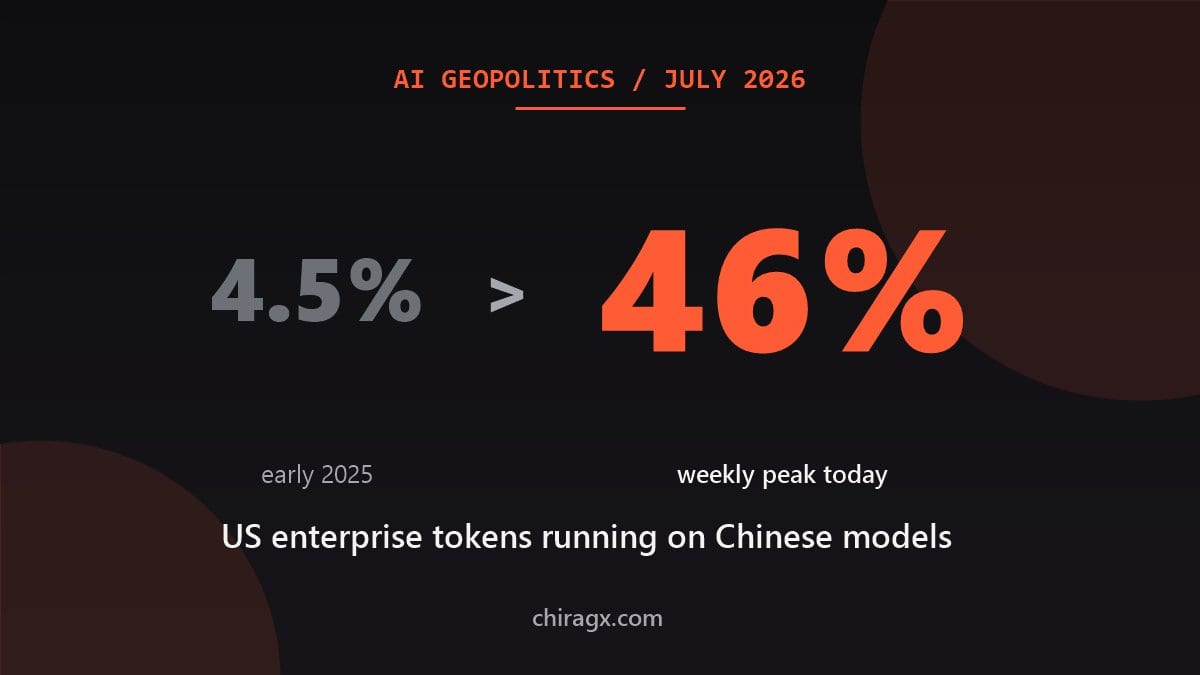
While the world argued about which American model is smarter, U.S. companies quietly moved the work. A CNBC investigation published this week confirmed it with data: between 30% and 46% of the enterprise tokens flowing through U.S. developer platforms are now processed by Chinese artificial intelligence models.
Read that again: of every two tokens American companies push through the most used model-routing platform, almost one now runs on a Chinese model. And it was not an ideological or geopolitical decision. It was a wallet decision.
The numbers behind the shift
From 4.5% to peaks of 46% in a year. In technology, that is not called a trend. It is called a stampede.
One scope note, because numbers get read with a magnifying glass on this blog: the data measures OpenRouter, the largest model-routing platform for developers, not the entire corporate market. It is a thermometer, not a census. But when the thermometer multiplies tenfold in a year, and Vercel, a separate platform, confirms the same direction, the signal is real.
Why it is happening: good enough, too cheap
The mechanics are simple and brutal. Open Chinese models cost 60% to 90% less than the leading Anthropic and OpenAI models, according to OpenRouter data. And the protagonist of the moment, GLM 5.2 from China's Z.ai, landed within one percentage point of Opus 4.8 on one of the most watched agentic benchmarks, charging roughly one fifth as much.
The pattern the platform data describes is exactly the one I apply in my own companies: when a task does not need the best model in the world, it gets routed to the cheapest one that does it well. The Chinese wave is winning that bet, and companies like Coinbase are already reported to have cut their AI spend by half using it.
What this means for your business
First, the good news: this is a price war, and in price wars the buyer wins. Artificial intelligence is becoming a commodity in layers: for the mechanical work of the day to day, cost is headed toward zero. The "AI is expensive" excuse died this year.
Second, the uncomfortable news: the cheapest model is not free, you pay in other currencies. Before routing your company's work to the model of the moment, there are questions the headline does not answer: where is your data processed and under what terms? Can you use it with client information or in regulated industries? Does it perform on YOUR task and in your language, or only on the marketing benchmark? And the one almost nobody asks: what happens if it disappears tomorrow?
That last one is not theoretical. We lived it a month ago in the opposite direction, when the most powerful U.S. model went dark overnight on a government directive. Geopolitics cuts both ways, and your operation cannot depend on two superpowers getting along.
The play: portfolio, not flag
That is how I run my own companies: a portfolio of models where each task runs on the engine it deserves by cost, quality and risk, and where no provider is irreplaceable. No tool gives you that. The judgment of whoever leads does.
If you want to build that map for your operation, deciding what gets routed cheap and what gets protected, that is exactly the work I do with companies and teams. See how I work or let's talk.
Sources

This is where I can help
Want to talk about your project?
Book an advisory call →Get every article in your inbox
AI and business analysis, no hype. Only when I publish something worth your time.