How I Run My Companies With AI: My Own Tools, Code Audits and Almost Zero Subscriptions
No theory: what I actually do
Every time I say I run my companies with AI, someone asks the same thing: but what do you actually do, day to day? Fair question, because most AI content is theory written by people who do not use it to make money.
So here is the honest summary: where I use AI every day, what I have built with it, how much time and money it saves me, and what I never delegate to it.
I built my own tools instead of renting them
A while ago I stopped paying almost every software subscription across my companies. Today I pay AI tokens for what I consume, not monthly per-seat fees. With AI as a development copilot, my team and I built the internal systems we used to rent:
Replaces management suites that cost 10 to 20 dollars per user per month.
Replaces CRMs that run from 50 to over 100 dollars a month.
Replaces accounting software of 30 to 90 dollars a month.
XY Task is the clearest example of why I build instead of rent. Part of my services run on outsourced providers, and I have clients I do not want connecting directly with those providers. That used to mean receiving the client's information, walking it over to the provider, and a back and forth that ate my hours. XY Task removes that drama: the client and the provider never have direct contact, but both see the requests in real time and resolve them inside my ticket system. The service feels mine from start to finish, because it is. And the same system runs the internal operations of my companies. No rented software was designed for that flow; mine is, because I designed it for my business.
And the key point: I do not write these tools line by line. AI drafts the code, I define the architecture, review and decide. That is how I can maintain several products at once without an army of developers.
Code audits and progress without bottlenecks
This is where I recover the most time every week. Before every important deployment, AI audits the code: security, bugs, architecture, performance. What used to mean days of manual review, or paying someone external, is now one afternoon of directed work.
And it is not just for my own products. This week, for example, we advanced the development of apexrecovlab.com together with my brother Joshua Henderson, who is about to launch his product: architecture, code audit and the final details before launch. The same process I run with clients every week.
Added up, that is easily more than ten hours a week back on my calendar. I reinvest them where AI cannot go: decisions, sales and relationships.
A recognition money cannot buy
Something happened this month that I want on the record. Google started showing me as a recognized figure: search "chiragx" and a Knowledge Panel appears, with my photo, my date of birth, my profiles and my companies.
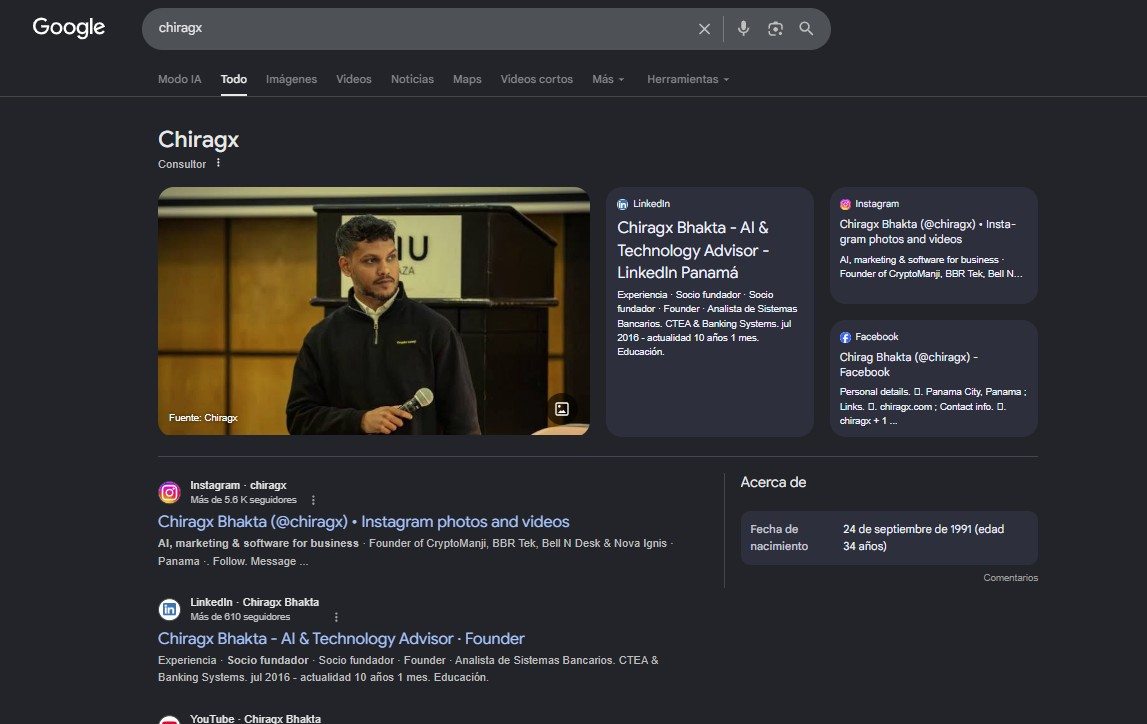
A panel like that cannot be bought. There is no ad, agency or shortcut that gets you one: Google only generates it when it considers a person a real public entity, with a verifiable track record behind them. For me it is the validation of years building companies, getting on stages across the region and publishing with consistency. Technology helps Google connect the dots, but what it recognizes is the journey.
What I delegate and what I do not
- ✓ Writing and fixing code
- ✓ Technical and security audits
- ✓ Research and fact-checking
- ✓ First drafts of everything
- ✗ Architecture and technical decisions
- ✗ Final approval of what ships
- ✗ Relationships and sales
- ✗ The strategy of my companies
Notice the pattern: everything I delegate is work with a clear deliverable I can verify. Everything I keep is judgment. AI proposes, I decide. The systems replace subscriptions, but they do not replace the person who knows what the system should do.
What this means for your business
You do not need an IT department to apply this. What I do with code, you can do with quotes, inventory, reports or customer service: the principle is the same. AI takes over the mechanical, repetitive work, and people are freed up for what actually brings in revenue: deciding, selling and building relationships.
The right question is not "which tool should I buy?". It is "what am I renting every month that could be mine?" and "which of my weekly tasks have a clear deliverable I could verify in minutes?". Those two lists are your starting point, and building them takes one afternoon.
If you want help building them for your operation, or setting up the full system with your team, that is exactly what I do. See how my AI consulting for businesses in Panama works or let's talk.

This is where I can help
Want to talk about your project?
Book an advisory call →Get every article in your inbox
AI and business analysis, no hype. Only when I publish something worth your time.