ChatGPT Wallet: your AI agent can now shop for you
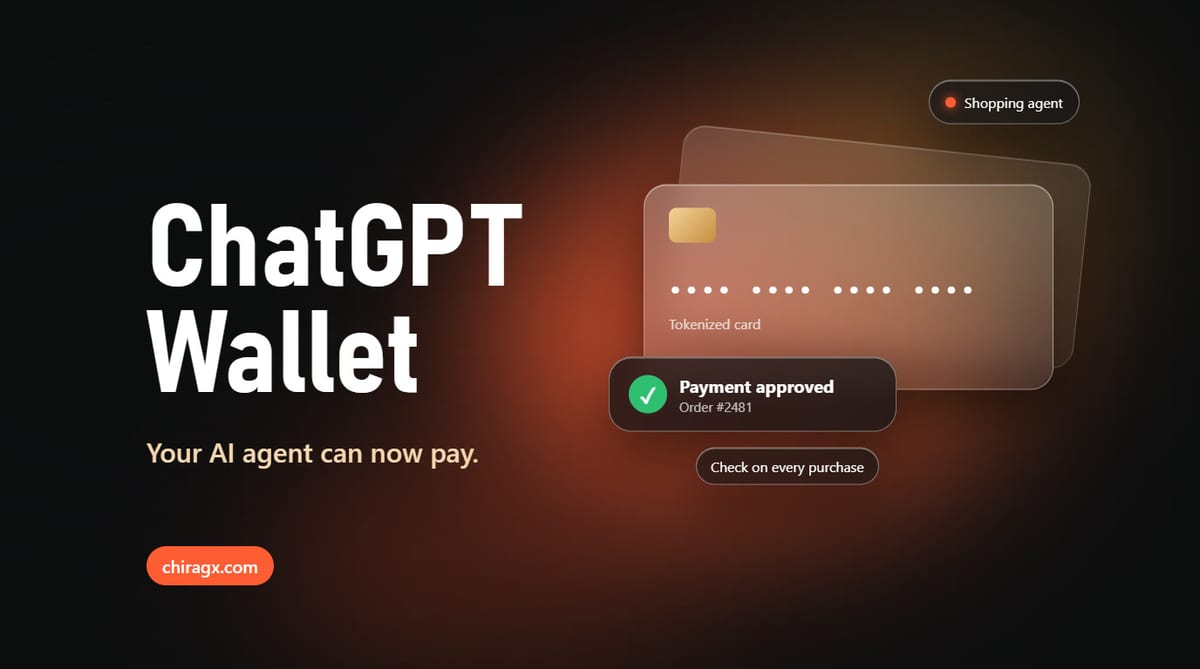
On November 13, 2026, OpenAI launched ChatGPT Wallet, a wallet that lets your AI agent pay for purchases on your behalf. The agent never sees your card number, and every purchase is approved with Face ID or a fingerprint. It was built with American Express, Chase, Mastercard and Visa.
It is the most serious step yet toward what is called agentic commerce: you don't just ask the AI to recommend a product, you ask it to buy it. Here is what it is, how it works, who can use it, whether it reaches Latin America and, above all, what your online store should do starting today. The facts come from OpenAI's official pages, linked at the end.
What ChatGPT Wallet is
ChatGPT Wallet securely stores your credit card so your agent, which OpenAI calls a dot, can complete purchases on websites for you. Dots are OpenAI's agents that work with their own cloud browser: they visit the store, compare, fill the cart and reach checkout.
What Wallet changes is the last step. Until now the agent stopped at checkout and you had to enter the details yourself. Now you only approve, and the payment is made with a substitute for your card.
OpenAI calls it "the first wallet that lets agents pay without access to users' actual card details."
How a purchase works
You add the card once, in a secure form and never typed into the chat. After that, every purchase follows the same path:

The key technical detail is step 5. According to OpenAI, the payment network provides a token: a card number, security code and expiry date that stand in for yours. The charge lands on your card, but neither the store nor the agent sees your real details. That is why your receipt may show a number different from your physical card.
One clarification from the help center: when you see "Ready to check out," your approval is complete, but it doesn't confirm the store placed the order. If the result is unclear, OpenAI recommends checking for the merchant's confirmation before trying again.
Is it safe?
The design has three layers:
- No real numbers. The agent and the merchant get a token, not your card.
- Human approval on every purchase. With biometrics, and each approval leaves a record of what you authorized.
- The usual rules. Your bank and the network still evaluate every transaction, and you keep your card's rewards and protections for eligible disputes, for example when an item arrives defective.
Even so, experts urge caution. James E. Lee, president of the Identity Theft Resource Center, told Yahoo Finance it is frontier technology that is "probably not appropriate for most people today," and better suited to people with a higher risk tolerance.
My practical advice: always check the total and whether there's a recurring charge before approving. If you accept a subscription, the store can keep the token and charge you again under those terms, and to cancel it you deal with the store, not with OpenAI.
Who can use it? Is it coming to Latin America?
Not yet. The launch is limited and OpenAI gave no dates for expanding it:

Two details that often confuse people: Wallet does not accept debit cards, only credit, and it works only in conversations with your dot, not in regular Chat, Work or standalone Codex. Chase cardholders must be the primary cardholder.
OpenAI says it is starting small to learn from real use and improve compatibility with merchants, banks and networks before opening it up.
If something goes wrong, who do you call?
This part matters for sellers. OpenAI doesn't become your store: the merchant is still the one who sells, charges and provides support.

The merchant guide says it plainly: customers are responsible for what their agent does, so stores should handle these orders just as if the customer had placed them directly.
Does OpenAI take a cut?
Not at launch. According to CNBC, OpenAI is not taking a percentage of Wallet transactions, although it could become a revenue stream later. There is no published fee for shoppers or merchants either.
From Instant Checkout to Wallet: why the approach changed
This isn't OpenAI's first attempt at selling inside ChatGPT. In September 2025 it launched Instant Checkout, which let people buy from Etsy sellers without leaving the chat. According to press reports, in March 2026 it pulled that and moved those payments to merchants' apps.

The real difference: with Wallet the purchase happens on the store's own website, with its usual checkout. That favors businesses with their own fast site and current prices and stock over those that only sell on marketplaces.
The card networks treat it as a controlled experiment. In the announcement, Luke Gebb of American Express describes it as their first "Agentic Commerce Experiences" integration and says they want to learn together from this early phase.
What your store should do starting today
Even if your customers in Latin America can't use Wallet yet, dots already browse the open web and visit stores in any country. And if you sell to customers in the US, this affects you now. OpenAI published a guide, the Commerce Partner Playbook, with what it asks of merchants:

- Check your firewall. OpenAI warns that many sites block its agents by accident. ChatGPT's browser visits are signed with a standard called Web Bot Auth, and Akamai, Cloudflare, HUMAN and Vercel already verify them. You just need not to block them.
- You don't need a new integration to get paid. The token arrives like any other card. The rule: don't store or reuse it, because the customer only authorized that one purchase.
- Tell your fraud provider. Risk systems can flag a legitimate agent purchase as suspicious and decline it. OpenAI is working with Stripe, Adyen, Checkout.com, Forter, Riskified, Sardine and Signifyd to prevent that.
- Clean up your catalog. You can claim your business in ChatGPT and upload a product feed. For now the standard upload targets the US; other countries need OpenAI's confirmation.
If your store runs on Cloudflare, the setting takes a minute: Security, Settings, filter by bot traffic, AI Crawler and Agent access policies, and under Personal Agents set "dots, OpenAI" to Allow.
What we still don't know
- When it reaches other countries, other plans or debit cards.
- When you'll be able to let the agent buy on its own, within spending, category or time limits. OpenAI says that's the plan, with no date.
- Whether there will ever be a fee for stores or shoppers.
- Whether a store outside the US can receive Wallet payments from a US customer. I found nothing official either way.
My take
For a business in Panama or anywhere in the region, Wallet doesn't move direct sales yet. What does change today is who visits your store: more and more, an agent will arrive before the person. If your site blocks agents, if checkout forces account creation or if prices are out of date, that customer goes to another store without you noticing.
Getting ready is cheap: check the firewall, allow guest checkout, keep prices and stock accurate and talk to your payment provider. It's what I showed live at eRetail Day: a simple, fast, clear store works for the person and for the agent.
Frequently asked questions
Does ChatGPT Wallet work in Latin America?
Not yet. At launch it is only for ChatGPT Pro subscribers who live in the United States, with US-issued credit cards and a US billing address.
Can I use a debit card?
No. OpenAI says Wallet doesn't accept debit or virtual cards at launch. Only US-issued American Express, Chase, Mastercard or Visa credit cards.
Does the agent see my card number?
No. After you approve, the card network generates a token with its own number, code and expiry date. Neither the agent nor the store receives your real details.
How much does it cost?
Wallet has no published extra cost, but today it requires a ChatGPT Pro subscription. According to CNBC, OpenAI takes no per-transaction cut at launch.
What does my store need to do to accept agent purchases?
Don't block ChatGPT's verified agents in your firewall or CDN, keep a standard checkout, don't store or reuse the token, and ask your fraud provider to recognize these purchases.
Sources
- OpenAI: Introducing ChatGPT Wallet (November 13, 2026)
- OpenAI Help Center: Making purchases with ChatGPT Wallet
- OpenAI: Commerce Partner Playbook and its agent access guide
- OpenAI: Buy it in ChatGPT (Instant Checkout) (September 29, 2025)
- CNBC, TechCrunch and The Paypers
- Yahoo Finance: the risks of ChatGPT Wallet
- IETF: Web Bot Auth draft

This is where I can help
Want this for your business?
Book your VIP Consulting session →Get every article in your inbox
AI and business analysis, no hype. Only when I publish something worth your time.