I read Panama's entire national AI strategy: here's what it means for your business
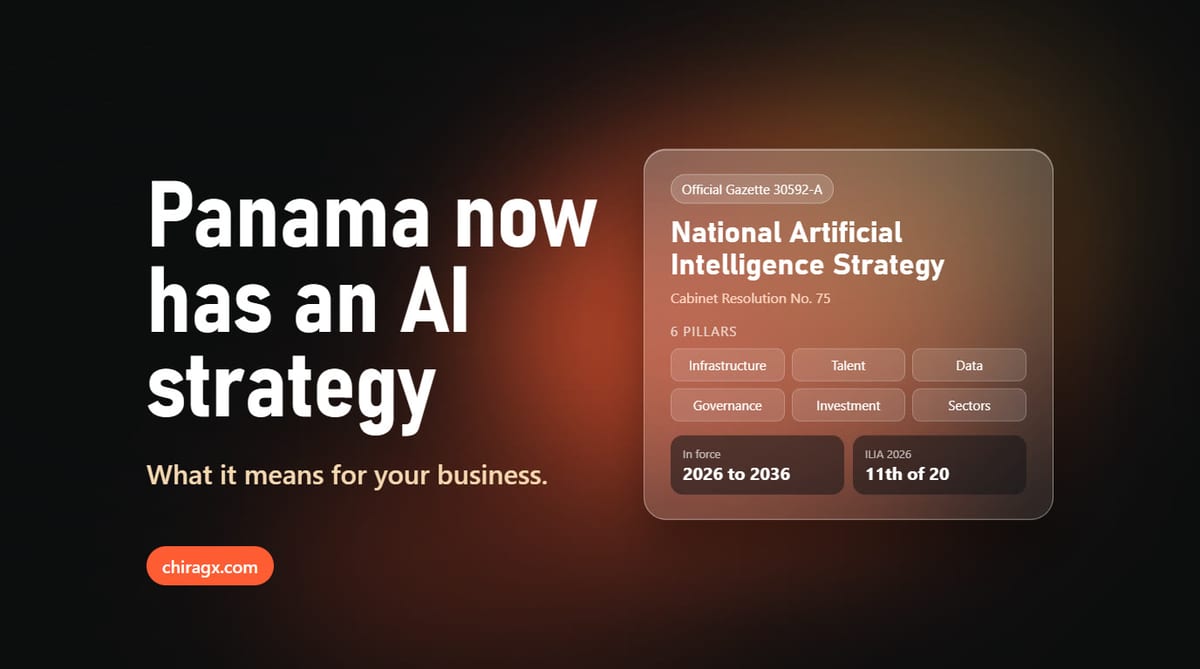
Panama now has a national artificial intelligence strategy. The Cabinet Council approved it on August 11, 2026, and it was published in the Official Gazette on August 18. It runs until 2036. Almost everything written about it so far is a two-paragraph press note, and several of those get the facts wrong.
So I did what I do with any document that affects my clients: I read the whole strategy. I read the Official Gazette version, which is a scanned document I had to run through text recognition, and the digital version Senacyt presented to the Chamber of Commerce. Then I cross-checked it against the Latin American AI Index, UNESCO's assessment of Panama, Law 81 on personal data, and what Senacyt, Georgia Tech, the banks and the press have said.
This article is the result: what it actually says, what it means for your business, what it leaves out and what I would do starting this week. It's long on purpose. If you only have a minute, look at the fact sheet below and jump to "What the strategy offers businesses."
The strategy at a glance

Three facts most write-ups get wrong:
- The resolution number. Senacyt and most of the press refer to "Resolution 89-26." In Official Gazette 30592-A, the issue that publishes it, it appears as Cabinet Resolution No. 75 of August 11, 2026. Most likely 89-26 is the Cabinet session's internal number and 75 is the official publication number. If you need to cite it in a formal document, use the Gazette's.
- It has six pillars, not four. A Panamá América article from February 2025 mentioned "four axes," but that was while the document was still being drafted. Georgia Tech's own release summarizes it in five. The approved text has six pillars.
- The vision is for Latin America. The official phrase is "Latin America's Trusted Hub for AI Innovation." The image that goes with it is the "Digital Canal": just as the country manages the transit of goods, it now wants to manage the transit of data, compute and talent.
The strategy comes from the resolution, but the legal groundwork came first: Executive Decree 36 of May 7, 2026 made critical and emerging technologies a national priority and created the National Commission for Critical and Emerging Technologies. That commission, chaired by the Minister of the Presidency, has an AI Subcommission coordinated by Senacyt, and that's who presented the strategy to the Cabinet.
"Technological opportunities don't wait; either we take them, or others will." Juan Carlos Orillac, Minister of the Presidency, when setting up the Commission on July 8, 2026 (translated).
How Panama got here

The work began in July 2025 with workshops in Panama City run by Senacyt and Tech AI, Georgia Tech's AI unit, plus an open national survey. The lead authors are Tim Brown and Pascal Van Hentenryck of Georgia Tech, and the project lead is Franklin Morales of Senacyt. According to the document, the process included workshops, interviews and a national opinion survey of more than 6,700 citizens.
On July 30, 2026, President José Raúl Mulino launched the National Agenda for Advanced Technologies, which brings together this strategy and the microelectronics and semiconductor strategy. Twelve days later, the Cabinet approved it.
"I call on business owners to invest, to adopt these tools in their operations and to train their workers, because every company that modernizes strengthens the whole country." José Raúl Mulino, President of Panama, at the July 30 launch (translated).
Where Panama stands today
Before looking at what the strategy promises, it's worth seeing where the country starts from. The best regional measure is the Latin American Artificial Intelligence Index (ILIA), published by Chile's National Center for Artificial Intelligence (CENIA) and ECLAC. The 2026 edition came out on October 20.

Panama scores 39.3 points and ranks 11th of 20, within the "adopter" group (35 to 60 points). Averaging the 20 scores gives 44.5, so the country is about five points below the region. Against its own history, the score barely moved: in ILIA 2025 it had 38.95 and also ranked 11th.
The ILIA 2025 country sheet, the latest with a breakdown by dimension, explains why:

- What Panama has: connectivity and data. It's above average on enabling factors (45.39 vs 43.81), with fast fixed broadband and good open data availability.
- People do use AI: individual use of generative AI ranks 5th in the region and web traffic to AI tools ranks 3rd.
- Companies and the state, not so much: in the same dimension, AI adoption by industry drops to 18th and by government to 15th. That's the gap that matters most for this article.
- Talent and innovation: human talent scores 30.99 against an average of 37.32, and innovation and development 20.36, ranking 17th.
- Governance: 33.89 against 47.57. The 2025 sheet summed it up this way: regulatory foundations and international ties, "but no national AI strategy." That's exactly the gap the 2026 strategy is meant to close.
UNESCO's assessment of Panama, done with its RAM methodology and presented alongside the strategy, puts it more bluntly:

The strategy doesn't hide any of this. It talks about a "national paradox": the country is a global connectivity hub, but it faces challenges in digital adoption, human capital and research investment. And it says so plainly:
"The biggest constraint on Panama's ability to adopt AI isn't technology, it's talent." Panama's National AI Strategy, section 4.1 (translated).
One more data point to complete the picture: Oxford Insights' 2025 Government AI Readiness Index, published in January 2026, still listed Panama among the countries that hadn't published a strategy and had one under development. That gap has just been filled.
The six pillars

1. Digital and physical infrastructure
This is the pillar most tied to the "Digital Canal" idea. It proposes sustainable data center zones with simpler permitting, a sovereign cloud for sensitive government data, high-performance computing shared between universities and startups, and a 100% digital coverage target. What's interesting is that it ties AI to energy: it notes that the National Energy Plan set a 70% renewable mix target for 2050 and that the target was already reached in December 2024. It also sets conditions: water for human consumption and for the Canal takes priority over any data center.
2. Human capital
It doesn't create an "AI class" in schools: it builds computational thinking into math and science. At the technical level, ITSE, UTP and INADEH would launch "technologist" degrees in data science and AI designed with the private sector, alongside a dual education model of 50% classroom and 50% workplace. There's a National AI Workforce Upgrade Initiative because, according to the text, a "reskilling emergency" is coming for routine administrative and logistics roles. And there are master's and doctoral scholarships with a return mechanism so talent comes back.
3. Data, security and protection
It builds on Law 81 of 2019 and its regulation, Executive Decree 285 of 2021. It says people should be able to know whether their data is used to train a model and to opt out. It announces a National Data Policy, open data via API (transport, weather, public procurement), a National Cybersecurity Institute specialized in AI security, a national team of ethical hackers and an AI Risk Observatory at Senacyt with annual reports. One important detail: ANTAI's new powers are conditional on reforming Law 81. They don't exist yet.
4. Governance and ethics
This is where the central institution sits: the National Institute for Applied AI (INIAA). It will be a Public Interest Association under Senacyt, with a mixed board, and the text insists it is "an agile execution engine, not a regulator." It will have a startup studio, an engineering team that builds minimum viable products for government and industry, and "sector nodes" that define use cases for each industry. This pillar also sets out risk-based rules, which I explain below.
5. Investment, entrepreneurship and partnerships
It includes a co-investment National Fund for AI Startups and Innovation, compute credits, the use of the SEM and EMMA regimes to attract regional headquarters and data centers of AI companies, an "AI concierge" service at the Ministry of Commerce for investors, and the document's most ambitious idea: "compute embassies," enclaves where other countries would host their data and compute in Panama under agreed rules. The text acknowledges the underlying problem: traditional banking is risk-averse and local venture capital is still nascent.
6. Application in strategic sectors
Nine sectors: logistics, financial services, agriculture, health, energy, tourism, government, manufacturing and construction. The strategy doesn't impose projects: it invites each sector to define its own roadmap. Some examples from the text:
- Logistics: a digital twin of the Canal, ports, railway and warehouses; a Panama Canal Authority pilot to predict water availability; customs using AI to flag high-risk containers.
- Finance: a shared pool across banks to detect fraud and money laundering, and credit scoring with alternative data for people with no banking history.
- Tourism: 24/7 AI assistants for bookings, flights and tours, and personalized marketing.
- Government: more than 400 Infoplazas turned into AI literacy centers, services with virtual assistants, a public register of every government AI system and a state Chief AI Officer at the AIG.
- Construction: BIM models, early warnings for cost overruns, and AI-assisted permits and inspections to "reduce discretion."
- Manufacturing: a Manufacturing 4.0 path for SMEs with co-financed assessments, sensors and AI quality control.
What the strategy offers businesses
I went through the document instrument by instrument and separated what exists from what's only announced:

- Available today: Talent Up Panama scholarships. 10,000 scholarships in AI, data analysis, cloud and cybersecurity, in partnership with Google, the IDB and UTP, requested through Panamá Conecta. It's the only thing a company can use tomorrow to train its people at no cost.
- For SMEs: micro-credentials and subsidies. The text says they will help SME employees master AI tools for immediate productivity gains, such as automated accounting and inventory management. There's no call or amount yet.
- Cloud and GPU credits. There will be a budget line for startups, university spin-offs and SME pilots aligned with the strategic sectors. Good news for anyone who wants to test a project without paying for the full infrastructure.
- Selling to the government differently. The text proposes "challenge-based tenders": the government describes a problem and local companies compete to solve it. For that to work, the public procurement law has to be reformed, and that hasn't happened yet.
- Paid pilots with multinationals. INIAA and MICI would run calls with SEM and EMMA companies so Panamanian startups can land their first large client.
- Regulatory sandboxes. Controlled environments where a company can test a new AI product under more flexible rules for a limited time.
The honest reading: the strategy puts SMEs on the radar, and that's new. It even says it will balance supply-side programs with instruments that drive AI demand in companies, "especially SMEs." But none of this has a call, an amount or a date yet.
The rules: what's coming and what already applies
The strategy isn't a law and creates no direct obligations for companies. But it does say how it intends to treat AI, and that points to what's coming:

- Risk-based approach. Systems affecting life, liberty or essential services (the text's examples are sentencing algorithms and medical triage) will need an ethical impact assessment and human oversight. The person affected must know the decision came from an AI, be able to ask for an explanation and ask for a person to review it. Minimal-impact applications, like inventory management, will face a lighter burden.
- Guidelines, not a law. The Commission should propose National AI Governance Guidelines. The strategy is explicit that it "rejects restrictive AI regulation."
- Bill 588 is still up in the air. It's the adaptive AI governance bill from deputy Jorge Bloise. It passed all three debates, but President Mulino partially vetoed it on September 28, 2026 and it went back to the Assembly. As of this article, it is not law.
- What already applies: Law 81 of 2019. If your company uses AI with personal data, you need consent, you must respect access, rectification, cancellation and objection rights, and article 19 gives people the right not to be subject to a decision based solely on automated processing that has negative effects on them, for example on their credit or job performance. ANTAI can fine from 1,000 to 10,000 balboas per violation.
- If you sell to Europe. The transparency obligations of the EU AI Act (disclosing that someone is talking to a chatbot or that content was AI-generated) have applied since August 2, 2026 to anyone offering those systems in the European Union, even if the company is based in Panama.
"Regulating before understanding is as risky as not regulating." Franklin Morales, project lead at Senacyt, to La Estrella de Panamá (translated).
If you want the legal detail country by country, I covered it in AI law for small business: what applies and what to do.
What the strategy doesn't say
A strategy is measured by what it gets done, and there are gaps worth keeping in mind:
- No amounts. The whole document contains not a single budget figure for AI. The semiconductor strategy, launched the same day, does: the president spoke of 105 million dollars. ILIA 2026 notes that across the region only Brazil and Colombia state a budget for their AI strategies.
- No numeric targets. It doesn't say how many people will be trained, how many companies will adopt AI or what share of GDP research spending should reach from today's 0.16%.
- The implementation plan isn't out yet. The text promises a phased plan with owners, timelines, milestones and indicators, coordinated by an office at Senacyt and the AIG. The AI Subcommission held its second session on September 21, 2026 to define how that plan will be built. Its chair, Eduardo Ortega Barría, described the job as moving "from conversation to coordination, from objectives to actions" (translated).
- The new institutions don't exist yet. INIAA, the National Cybersecurity Institute and both observatories are proposed, not created.
On the plus side: the document calls itself "state policy" and says its governance, funding and indicators are designed to outlast changes of government. And it's realistic about something few strategies admit: Panama doesn't need to compete by training giant models, but to win at the application layer, which is where businesses are.
"The launch of the strategy is an important milestone, but the real work begins with implementation." Timothy M. Brown, interim managing director of Tech AI at Georgia Tech and co-author of the strategy.
The gap that's up to your company
While the state builds its plan, the biggest gap isn't in government. It's inside companies:

- According to ILIA 2026, 27.6% of large companies in the region use AI, 12.8% of medium ones and only 6.8% of small ones. In Germany, Spain, Estonia, Portugal and Singapore the figures are 66%, 41% and 24%.
- An RSM survey of 461 business leaders in the region, published in September 2026, found that about 40% are already implementing AI, but only 18% have a formal AI governance framework, 17% have employee policies and just 4% report mature training.
- In Panama, banks already see the opportunity: speaking to La Estrella de Panamá, Banistmo talked about using these tools to offer SMEs better access to credit, and Tigo warned that cybercriminals use AI too and that the country's cybersecurity maturity is around 46%, versus about 65% in banking.
What I would do this week
There's no need to wait for the implementation plan. This is what I recommend to the companies I work with:
- Take inventory of where you already use AI. Chatbots, email, spreadsheets, your team's tools. Most companies use more AI than they think, with no rules.
- Write a one-page internal policy. Which tools are allowed, which data never gets uploaded, who reviews the output. Only 17% of companies in the region have one, and it's the fastest way to cut risk.
- Check Law 81 wherever personal data is involved. If an AI decides on credit, hiring or pricing for a person, make sure there's human review and that you can explain the decision. That's where the strategy is heading, and it's already a legal right.
- Train your team with what already exists. Talent Up scholarships are available today. When the SME micro-credentials come out, you'll be ahead. I wrote about this in AI training for your team: why it is now mandatory.
- Pick one pilot process and measure it. Just one, repetitive and with a clear answer. If it works, that measured case is exactly what any compute credit call or challenge-based tender will ask you for.
- If you sell technology, get ready to sell to the government. Challenge-based tenders and pilots with multinationals are designed for local companies. Have a documented use case in one of the nine sectors.
My take
I like it more than I expected to. It's a serious document, written with method, that doesn't promise Panama will build the next ChatGPT and understands that the country's edge is applying AI to logistics, finance, tourism and government. INIAA as an execution engine rather than a regulator, sandboxes and challenge-based tenders are the right ideas.
But today it's a map, not a road. With no budget, no targets and no published implementation plan, the risk is the usual one in the region: lots of documents and few actions. The good news for a business owner is that the most important part doesn't depend on the state. Using AI with clear rules, training your people and measuring a first case are things you can do this month, with or without a national fund.
People in Panama already use AI more than the regional average. What's missing is companies using it. That gap is ours to close.
Frequently asked questions
When was Panama's National AI Strategy approved?
The Cabinet Council approved it on August 11, 2026 through Cabinet Resolution No. 75, published in Official Gazette 30592-A on August 18, 2026. Senacyt cites it as Resolution 89-26. It had been publicly launched on July 30, 2026.
Does the strategy require my company to do anything?
Not directly. It's public policy, not a law. What does apply today is Law 81 of 2019 on personal data protection, which covers any use of AI with people's data.
Does Panama have an artificial intelligence law?
Not yet. Bill 588 on adaptive AI governance passed all three debates in the Assembly, but it received a partial veto from the president on September 28, 2026 and must be debated again.
Is there funding or support for SMEs?
The strategy announces micro-credentials and training subsidies for SME employees, cloud and GPU credits for SME pilots and a Manufacturing 4.0 path. None has an amount or a call yet. What's available today are the 10,000 Talent Up Panama scholarships on Panamá Conecta.
What is INIAA?
The National Institute for Applied AI, proposed as a Public Interest Association under Senacyt. Its role is to execute and connect companies, universities and government, not to regulate. It hasn't been created yet.
Where does Panama rank in AI in Latin America?
In CENIA and ECLAC's 2026 Latin American AI Index, Panama scores 39.3 points and ranks 11th of 20 countries, below the regional average.
How long does the strategy last?
From 2026 to 2036, with reviews every three years, according to the document itself.
Sources
- Official Gazette No. 30592-A, August 18, 2026: Cabinet Resolution No. 75 and the full text of the strategy (Spanish)
- Panama's National Artificial Intelligence Strategy, digital version (Panama Chamber of Commerce, Industry and Agriculture; Spanish)
- Senacyt: Cabinet approves the National AI Strategy (August 12, 2026)
- Senacyt: launch of the National Agenda for Advanced Technologies (July 30, 2026)
- Senacyt: the National Commission for Critical and Emerging Technologies is set up (July 8, 2026)
- Senacyt: second session of the AI Subcommission (September 22, 2026)
- Georgia Tech: Georgia Tech Partners With Panama to Chart National AI Strategy (October 20, 2026)
- Georgia Tech: workshops and national survey (July 10, 2025)
- CENIA: ILIA 2026 results (October 20, 2026) and the ILIA website
- Bloomberg Línea: ILIA 2026 scores by country (October 22, 2026)
- ILIA 2025: country sheets and methodology (CENIA and ECLAC)
- UNESCO: Panama profile in the Global AI Ethics and Governance Observatory
- Oxford Insights: Government AI Readiness Index 2025
- RSM: AI Readiness in Latin America Survey Report 2026
- Law 81 of March 26, 2019 on personal data protection (text on vLex; Spanish)
- Panamá América: partial veto of Bill 588
- La Estrella de Panamá: Panama aims to become AI's "Digital Canal"
- La Estrella de Panamá: banks and telecoms see opportunities in the strategy (August 27, 2026)

This is where I can help
Want this for your business?
Book your VIP Consulting session →Get every article in your inbox
AI and business analysis, no hype. Only when I publish something worth your time.