Hack, maintenance or coincidence? The truth behind the FAA, Chase, NSA and FBI outages
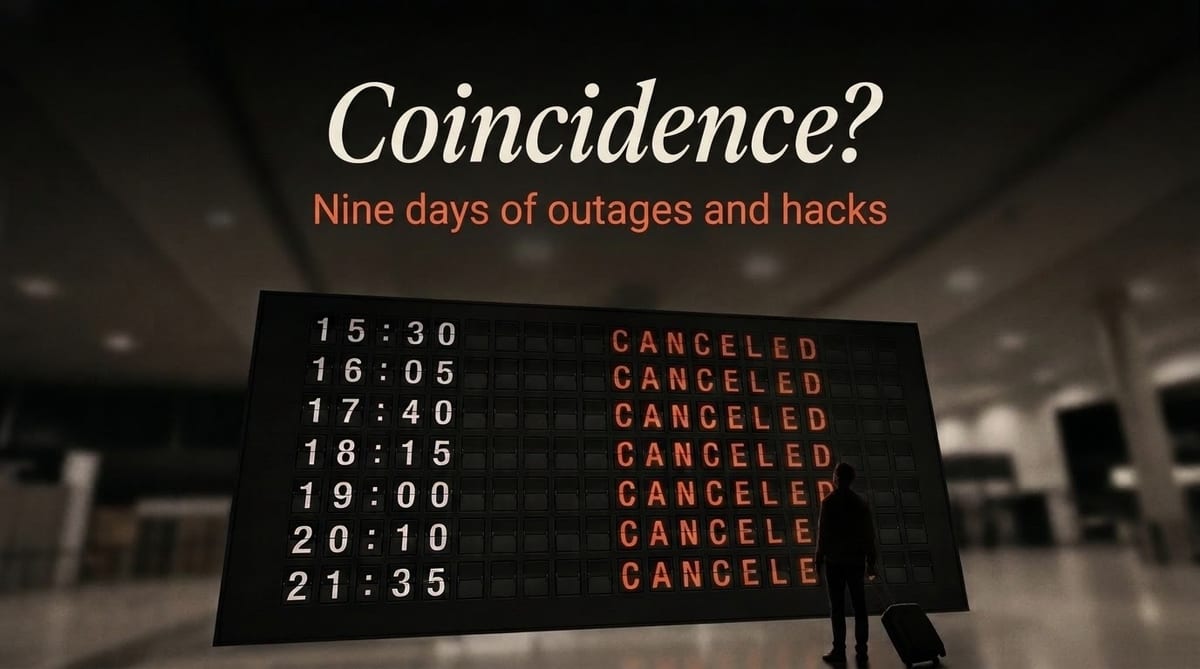
More than 4,000 planes were in the air when the United States switched off its sky. It was Friday the 13th. And it wasn't the worst of the week.
In nine days, everything that was never supposed to go down went down. Email for half the world. The biggest bank in the United States. The secret network of the NSA, the most powerful spy agency on the planet. Vendors of Chase, Visa and Mastercard, hacked. Nvidia's chief, out over an espionage scandal. And the FBI, investigating an intrusion into the database 18,000 police agencies rely on.
Everyone asked the same question: is it a coincidence, are we being hacked, or can the systems just not take it anymore? One senator was blunt: "You can't tell me it's a coincidence." The vice president had to go on television to say there was no need to build a bunker. And Trump, from China, asked for calm: "Tell them to relax."
I went through every outage one by one, using official statements, congressional hearings and reporting by Reuters, AP, CNN and CBS. The answer isn't the one going around on social media. And there's a lead that connects almost everything.
The short answer: hack, maintenance or overload?
- Confirmed hacks: the vendors of Chase, Visa and Mastercard; Optimizely, a tool attackers used to infect 188 scripts on sites like CNN and the BBC; and Fireworks AI, through which data from Uber, Cursor and Notion was stolen. The FBI is investigating a possible intrusion it hasn't confirmed yet.
- Maintenance and updates: the NSA went down installing a security patch, Apple because of an internal update, and the FAA because of a switch from copper cable to fiber optics.
- Errors and overloads: Microsoft, because of a July bug that blew up with more traffic and less capacity than normal, and Chase, because of a software bug.
- A coordinated attack? There's no evidence at all. But it isn't pure coincidence either: almost everything shares an underlying cause, and it's at the end of this story.
Prologue: what was brewing in October
To understand November, you have to go back a few weeks, because the signs were already there.
On October 21, OpenAI announced that one of its models had found a critical flaw in PHP, the language that runs a large share of the world's websites. Wiz had found it on its own with other AI tools. According to Palo Alto Networks, 22.6 million servers were potentially vulnerable, and OpenAI warned: "we expect similar findings to increase sharply in the coming months." A race against the clock began to patch it before attackers could use it.
That same month, Microsoft fixed 1,411 flaws in a single monthly update, the largest in its history. A year earlier, the figure was around 170.
And attackers weren't waiting. On October 29, hackers stole $6.3 billion in crypto from Binance in about 20 minutes, the largest crypto theft ever; the FBI confirmed it was North Korean state hackers. In France, some 700 supermarkets had their refrigeration systems sabotaged, with at least 15 fires, and the French government ended up blaming a cyber unit of Iran's Revolutionary Guard.

Keep that number in mind. It comes back at the end of the story.
Chapter 1. Thursday the 12th: the day Outlook went dark

At 11:20 a.m. New York time, Outlook, Teams and Copilot started failing worldwide. It lasted almost 24 hours. At the worst point, more than 80% of the servers that route Microsoft's email stopped responding.
Microsoft's preliminary report explained the cause: a bug hidden in an update installed in July, which blew up when heavier-than-normal traffic met reduced capacity. Microsoft was categorical: it was not a cyberattack. It was the first sign of a pattern that would repeat all week.
Interlude. That same Thursday: Nvidia's chief falls

While Outlook went dark, another giant piece fell in California. On November 12, Jensen Huang, Nvidia's founder and the face of the AI boom, resigned as CEO. Chief financial officer Colette Kress became interim CEO, according to the filing Nvidia made with the SEC.
The story went back to late October, when The New York Times reported that U.S. officials believed Huang had a close relationship with Alice Huang (no relation), a Chinese tech executive who, according to those sources, might be working for Chinese intelligence. Espionage has a name for that: a "honey trap." On November 8, the board opened an investigation and Huang admitted in an internal message that he had been unfaithful to his wife. Four days later, he was gone.
Two important clarifications. The suspicion is about China, not Russia, and it wasn't a hack. It isn't proven either: Nvidia says there's no evidence any sensitive information was shared, and the Justice Department said it has not yet concluded whether Alice Huang was a spy. Nvidia's shares fell on the news.
The hack came separately. On November 18, The Gentlemen, a ransomware group Cybernews links to Russia, put Nvidia on its leak site and threatened to publish data on November 28, without showing any proof. Nvidia responded: "NVIDIA is investigating an incident that may have affected a third-party partner", and said it found no indication its own systems were affected. Once again, the way in would be a vendor.


Chapter 2. Friday the 13th: empty skies


The ground stop lasted more than four hours. More than 9,000 flights were canceled that Friday and more than 5,000 the next day. Homeland Security Secretary Markwayne Mullin later said they landed more than 4,000 planes that were in the air.


What happened? A contractor, L3Harris, was replacing copper cable with fiber optics in El Dorado, Arkansas. A new router started flooding the air traffic control network with connection attempts, and the chaos reached 17 of the country's 22 major control centers. Transportation Secretary Sean Duffy was blunt: "So we don't believe this was cyber at all." It's still unknown whether the router was faulty or misconfigured, and the FAA disabled every router of that model.
Two days later, President Trump broke his silence on social media with someone to blame: "The Biden Administration was an FAA disaster." He later said on Fox that the problem is a 55-year-old system.
Chapter 3. Monday the 16th: money stops moving
Transfers and Zelle payments from Chase got stuck for hours, and the problem spilled over to Bank of America and Wells Fargo customers. Chase blamed "a software bug in an on-premise hardware system" and said it was not an attack. That same afternoon, a systems failure delayed United Airlines departures by more than 90 minutes.
That Monday a real attack was also discovered, though almost nobody noticed: someone exploited a flaw in Optimizely, a tool used by thousands of websites, and injected malicious code into 188 scripts belonging to 178 organizations, including CNN, the BBC and Zoom. The code tried to steal cards and crypto from people visiting those sites.
Chapter 4. Tuesday the 17th: the strangest day
If one day fueled the theories, it was this one.
In the morning, NSANet, the National Security Agency's classified internal network, went down. By the end of the day, the Fort Meade headquarters had closed to most staff. The NSA spoke of "temporary degradation during scheduled routine maintenance." What it didn't say, and CBS reported with several sources, is what it was patching: the same PHP flaw that AI had found in October.


Hours later, Apple signed users out of iCloud and took down the App Store, Apple Music and payments at many of its stores. Its explanation: an internal update. That same day, Marriott locked everyone out of its app, Rakuten Securities in Japan disclosed a breach that could affect up to 11.25 million accounts, Norwegian energy giant Equinor detected a cyberattack and someone used leaked credentials to get into Rackspace's cloud.
Trump was touring Asia. In Manila, asked about the outages, he said: "It's life. When you're big and powerful and you have all the money, things like that happen. It's fine." In Washington, Republican Senator Josh Hawley was less relaxed: "You can't tell me it's a coincidence," he said, adding: "Maybe I'm wrong. I hope I'm wrong."
Chapter 5. Wednesday the 18th: Congress asks questions
The House Homeland Security Committee had its annual threats hearing scheduled, and it turned into an interrogation about the outages. Director of National Intelligence Jay Clayton was clear: "They are not a coordinated or state sponsored attack." He described them as "separate service outages associated with maintenance and technical changes."
FBI Deputy Director Christopher Raia added: "At this point, there is no indication whatsoever that there is any cyber malicious activity related to any of those incidents." And Mullin said he was "98% confident" no foreign adversary was behind it.
Not everyone was convinced. Democrat Dan Goldman pressed Clayton on the NSA and ended up telling him: "You're a very smart person, and you're clearly not answering my direct questions." Republican Nick LaLota admitted he worried that the week's events went beyond coincidence. That night, Vice President JD Vance said on TV that friends were asking him whether they should build a bunker and stock up on food and water. His answer was no.
Chapter 6. Thursday the 19th: the real hack

Up to this point, almost everything had been self-inflicted. On Thursday came a confirmed hack. Chase posted: "third parties who provide services to the firm were the target of a cyber attack." The attackers got into vendors holding marketing data, including some customers' names and email addresses. Visa and Mastercard confirmed similar incidents the same day.
Behind it is an extortion group called n0n. It appeared in September, claims nearly 200 victims (researchers believe the number is inflated) and, according to the firm SOCRadar, probably operates out of Russia, with one or a few people using an AI coding assistant. Its way in may have been Qubole, a data vendor several of these companies share, though that's not confirmed yet. Days earlier, n0n had claimed the Expedia data theft through the same route.
That Thursday, Broadcom also patched a VMware flaw that, according to Google, a Chinese espionage group had been secretly exploiting for at least two months. And from China, where he was still touring, Trump asked the country for calm on Fox: "Tell them to relax. Everything's good."
Chapter 7. Friday the 20th and Saturday the 21st: the FBI
On Friday, Trump fired National Cyber Director Sean Cairncross in the middle of the crisis, saying he didn't think he was good enough. On the Senate floor, Democratic leader Chuck Schumer told him to stop telling Americans to relax and tell them the truth about what was causing the outages, and asked for an expert team to report to Congress by December 1.

That night, CNN, NBC and ABC reported, citing sources, that the FBI is investigating a possible intrusion into NCIC, the database some 18,000 police agencies query for warrants, missing persons and criminal records. As of Saturday night, the FBI had neither confirmed nor denied it: "The FBI declined to comment." It's unknown when it happened, how they got in, who did it or whether data was altered.
What is known is that it wouldn't be the first time this year. In February, the FBI detected suspicious activity in its wiretap system. In September, the ShinyHunters group stole data through FBIJobs.gov because a contractor hadn't installed a security patch. This would be the FBI's third incident of 2026.


On Saturday, Trump addressed it on Fox: "I will say that it's not good. I don't like that." According to UPI, he added that he likes to put a positive spin on things and suggested it might reveal something about voter fraud. ABC noted that NCIC doesn't hold that kind of information.
Meanwhile, in the rest of the world

While the United States stared at its outages, the rest of the world didn't have a quiet week either:
- Europe: on November 1 and 2, a second wave of supermarket fridge sabotage reached at least 11 countries, including Belgium, Sweden, Ireland and Estonia, where temperatures were set to 50°C. On November 9, France formally blamed Iran.
- France: the bank Crédit Mutuel Arkéa suffered fraudulent transfers of about 118 million euros through a vendor, according to the French press.
- Japan: besides Rakuten, the retailer Nitori reported the theft of 37.6 million customer records.
- Brazil: the Port of Santos, the country's largest, suffered an attack that knocked out its administrative systems, and the exchange Mercado Bitcoin lost tens of millions of dollars in crypto.
- Chile: the University of Chile's Clinical Hospital suffered a cyberattack that disrupted its scheduling systems.
- Silicon Valley: hackers broke into Fireworks AI, an AI model provider, twice, and stole its customers' data from there. Uber notified 149,346 people that driver's license information was taken; Cursor said attackers used a stolen key to publish a fake Claude Code extension that may have reached about 5,000 users, and Notion said fewer than 1% of its workspaces were affected.
- Ukraine and Russia: hackers sent fake radiation and chemical attack alerts through both countries' emergency apps.
In Panama I found no major incident reported in those weeks, but the national CSIRT issued alerts about flaws already being exploited. Nobody is off the map.
Do they hide hacks to protect their stock?
It's the logical suspicion: if a company admits it was hacked, its stock falls; if it says "technical failure," it doesn't. I went through the cases one by one.
Binance isn't publicly traded, and it still didn't hide it. It froze deposits and withdrawals the same night, October 29, confirmed the theft and the amount the next day, and promised to absorb the loss with its emergency fund and its own treasury: "Binance will absorb the financial impact of these stolen funds, not our users." It reopened withdrawals on November 1. Where there are doubts is in the how. It first pointed to an engineer's hacked laptop and later to a "more complex" process, and Mark Karpelès, the former head of Mt. Gox, told Reuters the attackers probably had the keys to at least two wallets, which Binance denies. Of the $6.3 billion, by mid-November about $2.82 billion was frozen and just $32 million recovered.
For companies listed in the United States, hiding a hack is illegal. Since December 2023, the SEC has required them to report a material incident within four business days of concluding it is material. And it has already punished downplaying: in October 2024 it fined Unisys, Avaya, Check Point and Mimecast for describing their hacks as smaller than they knew they were.
What they all do is choose their words carefully. That week a formula kept repeating: talk of "an incident," of an outside vendor, and of no indication that the company's own systems were affected. Chase separated Monday's outage, which it blamed on a software bug, from the hack of its vendors, which it announced three days later. Nvidia spoke of a "third-party partner." It may be true in each case, but it's also the way of telling it that scares investors least.
Based on what has been published, I found no evidence that any of these companies hid a hack behind a "technical failure." The silence that stands out is a different one: the FBI's.
The theories
Social media filled with talk of cyberwar, Iran and a false flag operation. The questions didn't come out of nowhere: in Congress, lawmakers from both parties demanded answers, and Republican Representative Mike Lawler said "a lot of coincidences" were happening at once.
But the theories run into the facts that are public today:

- Each company gave a different cause, and no source found a shared cloud provider, network or update.
- The FAA, Microsoft, Chase, Apple and the NSA had self-inflicted failures with concrete technical explanations.
- The week's confirmed hacks have different authors: an extortion group that gets in through vendors, criminals who attacked Optimizely and, in the FBI's case, no one identified yet.
- The countries that did attack in those weeks (North Korea with Binance, Iran with the fridges, China with VMware) did it elsewhere, and there's no evidence linking them to the US outages.
Based on what's known today, it wasn't a coordinated attack. But it wasn't pure chance either.
The lead that does exist: a race against AI
Remember the PHP flaw AI found in October? That's the piece that connects almost everything.

AI models from Anthropic, OpenAI and Google are finding vulnerabilities at a speed never seen before. In April, Anthropic said its Mythos model had already found "thousands" of high-severity flaws, some in every major operating system and browser. In October it was PHP's turn. The numbers show it: about 48,000 vulnerabilities were published in 2025, and 2026 passed 72,000 by September alone.
Every flaw found is a patch someone has to install fast, before an attacker with the same tools exploits it. On November 13, the FBI warned about ARTEX, an AI security testing tool criminals are using, which in some cases gets privileged access in under three hours.
So did things go down because companies were updating so they wouldn't get hacked? Partly yes, and it's the strongest explanation there is. The NSA went down installing the patch for the PHP flaw. Microsoft kept up a record pace: after October's 1,411 fixes, it shipped roughly 1,100 more in November, one of them for a flaw already being exploited. Other outages came from changes that weren't about security, like the FAA's fiber work or Apple's internal update. But the mechanism is the same: the faster old systems have to change, the easier it is for something to break.
And patching at full speed breaks things. The NSA case is directly tied to an urgent patch. Clayton put it this way at the White House: "Our systems need upgrades. They need patching." According to a report from The Washington Sun based on anonymous sources, bank and NSA executives privately told members of Congress that several outages came from "rushed fixes for AI-found flaws." That report is unconfirmed and the affected companies gave other causes, but several experts find it plausible. Google's John Hultquist warned that we'll probably face a choice between taking systems down temporarily to keep them safe or taking the risk.

Democratic Senator Mark Warner, who will chair the Senate Intelligence Committee, said it plainly: "Chances are there's going to be more of these outages because nobody is slowing their efforts to try to patch." Mullin, from the Trump administration, agreed: he believes there will be more cases like this as new technology rolls out. It was one of the few things both parties agreed on that week.
Epilogue: the week AI was worth more than ever
The irony is that, in the middle of all this, the AI industry had the biggest week in its history:
- November 17: OpenAI launched GPT-6.2 Astra and Sol, and Microsoft unveiled seven in-house models, including one just for cybersecurity.
- November 18: Google launched Gemini 4 Neon, and Anthropic priced its IPO at $83 a share.
- November 19: Anthropic started trading, opened at $111.50 and raised $81.3 billion, the largest IPO in history according to CNBC.
- And ten days earlier, Claude Fable 5.2, its most powerful model, had come out.
The same models worth hundreds of billions on the stock market are the ones finding the flaws that force the whole world to patch in a rush. AI is, at the same time, the tool that protects the most and the one that adds the most pressure.
The verdict
It wasn't a coordinated attack, at least based on everything that's public today. It was something harder to accept: complex, aging, interconnected systems that fail when touched, criminals who get in through the weakest vendor, and AI that finds holes faster than companies can calmly plug them. There was no villain. There was a race, and that week a lot of people stumbled at the same time.
Open questions remain: what really happened in the FBI's database, what the FAA's final report will say and what the expert team the Senate asked for will find. If something new comes up, I'll update it here.
What your company should do
You don't have to be a bank for this to affect you. These are the lessons of the week:
- List your vendors and which customer data each one holds. If one gets hacked, you need to know within minutes what could have leaked.
- Have a plan for when what you use every day goes down. If Outlook or your bank stops working for a day, how do you serve customers, get paid and communicate?
- Patch fast, but not everything at once. First on one machine or a small group, then the rest. That way a patch doesn't shut down the whole company.
- Prepare your team for the phishing that comes next. When names and emails leak, fake messages pretending to be the bank follow.
- Use AI to defend yourself: to review your code, your settings and your access before someone else does with the same tools.
If you want to check how exposed your company is, or build a plan to keep operating when a vendor fails, let's talk.
Sources
- OpenAI: Coordinated disclosure of critical vulnerabilities
- Cloud Security Alliance: Patch volume saturation and AI discovery
- BleepingComputer: FBI links $6.3 billion Binance crypto heist to North Korean hackers
- The Record: France blames Iran for fridge cyberattacks
- BleepingComputer: Microsoft says months-old bug caused global Microsoft 365 outage
- Al Jazeera: What forced the US to ground all planes
- CNBC: Trump breaks silence on FAA nationwide ground stop
- AP via KUOW: A technical issue at JPMorgan Chase triggers online banking delays
- BleepingComputer: Optimizely supply chain attack
- CBS News: NSA network outage linked to software vulnerability
- The Record: NSA continues response to NSANet problems
- MacRumors: Apple outage caused by internal update
- AP via OPB: Rubio says there's zero information that outages were caused by a malign actor
- Fox Bangor (TMZ): Sen. Josh Hawley says outages feel like a possible coordinated cyberattack
- CBS News: Homeland Security hearing on network outages
- The Record: House Homeland committee testimony on tech disruptions
- KOMO News: Trump tells Americans to relax as tech outages disrupt flights and banks
- The Next Web: JPMorgan Chase, Visa and Mastercard vendor breach
- The Register: The n0n extortion group
- Cybersecurity Dive: Chinese espionage group exploits VMware vCenter zero-day
- Fox News: National Cyber Director fired
- NBC News: FBI investigating potential breach of crime database
- ABC News: FBI's national crime database targeted in hack
- UPI via Yahoo: Trump downplays FBI data breach
- The Hacker News: FBI removes contractor after FBIJobs breach
- The Record: FBI flash alert on the ARTEX AI tool
- Anthropic: Project Glasswing
- The Next Web: US outages blamed on rushed patches for AI-found flaws (not independently verified)
- Politico via Yahoo: AI driving mass tech outages
- WHRO: Sen. Mark Warner on the network outages
- Anthropic: Anthropic prices initial public offering
- Nvidia SEC filing: NVIDIA announces CEO transition
- NPR: Nvidia CEO Jensen Huang steps down amid alleged spy scandal
- The Washington Post: Jensen Huang resigns as Nvidia CEO after affair with alleged spy
- ABC News: Nvidia CEO Jensen Huang resigns amid alleged affair with reported spy
- BleepingComputer: NVIDIA investigating Gentlemen ransomware breach claims
- Cybernews: Nvidia ransom demand by The Gentlemen
- Al Jazeera: Binance says $6.3bn stolen in biggest crypto heist in history
- CNBC: Binance resumes withdrawals following $6.3 billion hack
- Crypto Briefing: Binance hack: $2.82 billion frozen, only $32 million recovered
- SEC: SEC charges four companies with misleading cyber disclosures
- TechCrunch: Uber says hackers stole information on close to 150,000 driver's licenses
- The Hacker News: Stolen Fireworks AI key led to Cursor incident
- This Week in Security: November 15, 2026 edition
The photos are from Wikimedia Commons, with their author and license in each caption. The illustrations are original, made with AI.

This is where I can help
Want this for your business?
Book your VIP Consulting session →Get every article in your inbox
AI and business analysis, no hype. Only when I publish something worth your time.