Anthropic goes public: what its SEC filing reveals
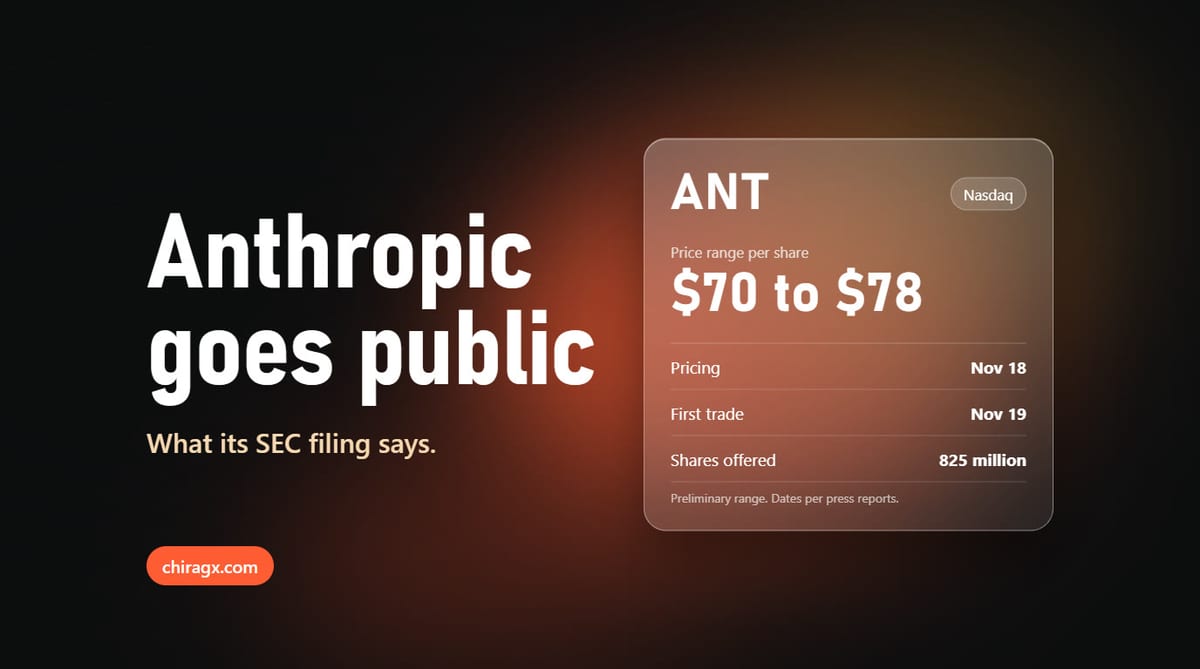
Anthropic, the company behind Claude, is days away from going public. Its filing with the SEC, the US securities regulator, sets a range of $70 to $78 per share, and it will trade on Nasdaq under the ticker ANT. According to CNBC, the final price is set on November 18 and shares start trading on the 19th.
At that range, Anthropic would be worth between $916 billion and just over $1 trillion, and the offering would rank among the largest ever. I read the prospectus it filed with the SEC to tell you what it actually says: how much it sells, how much it loses, who's in charge and what risks it admits. Every figure comes from that document or from company announcements, except where I say otherwise.
Note: this article is for information only. It is not a recommendation to buy or sell, and I am not a financial advisor.
The essentials in one table

- 825 million Class A shares. Anthropic sells 801.35 million and existing holders sell 23.65 million; the company gets no money from the latter.
- A $26 billion private placement at the IPO price, in non-voting Class N shares, with AMD, Broadcom, Google, Micron, Microsoft, Nvidia and TSMC.
- Lead banks: Goldman Sachs and Morgan Stanley.
- Timeline: Anthropic filed confidentially in June 2026, made the filing public on October 26 and set the price range on November 10.
How much Anthropic sells
The most striking thing in the prospectus is the speed of growth. Revenue went from $376 million in Q1 2025 to $16,956 million in Q3 2026.

For all of 2025 it booked $4,585 million. Q3 2026 grew 1,127% over the same quarter a year earlier.
The prospectus opens this way: "For the first time in history, intelligence is something humans can build."

Does it make or lose money?
It depends on which line you look at, and this is where it's easy to get confused:
- A huge net loss. $41,965 million in 2025 and $104,039 million from January to September 2026. But almost all of it is accounting: changes in the value of convertible notes, derivatives and other instruments that are marked up as the company becomes more valuable. In Q2 2026 alone that adjustment came to $59,597 million.
- Operating results near breakeven. It earned $974 million in Q2 2026 and lost $567 million in Q3.
- Positive adjusted operating income. Excluding stock compensation and some one-off charges, its adjusted margin was 19% and 15% in those two quarters. That's the company's own metric, not an accounting standard.
The biggest expense is compute: almost $10 billion in Q3 2026 alone. And future commitments are enormous: about $900.9 billion, almost all compute and infrastructure, of which $70.7 billion falls due in the 12 months after September 30, 2026.
On the other side, it holds $95.6 billion in cash and $36.3 billion in short-term investments, plus $14.8 billion available on a credit line.
Who's in charge: the detail that matters most
Buying Anthropic shares gives you almost no power over the company. The structure has five share classes:

- The seven co-founders, including Dario Amodei (CEO) and Daniela Amodei (president), control an entity holding a single Class F share with 50.1% of the vote and no economic rights.
- The Long-Term Benefit Trust, a trust of people who hold no company shares, elects a majority of the board.
- Anthropic is a public benefit corporation (PBC): its legal mission is the responsible development of advanced AI for the long-term benefit of humanity.
The filing itself warns that Class A holders "generally will not be able to affect the outcome" of any vote.
What Anthropic is worth

The figure depends on how many shares you count. With the 13.087 billion Class A and N shares outstanding after the offering, the range gives $916 billion to $1.02 trillion. Adding employee options and restricted stock (fully diluted), press reports put it at up to $1.4 trillion.
By size, the public offering of $57.75 to $64.35 billion (not counting the private placement) would trail only SpaceX's June 2026 IPO, according to press reports, and sit far above Saudi Aramco in 2019.
The risks the company itself admits
- Losses since its founding, and a warning that it may not achieve or sustain profitability.
- Dependence on compute and on the spending commitments above.
- Dependence on the clouds: 44% of revenue from January to September 2026 came through cloud provider marketplaces.
- Founder control and a governance structure without clear legal precedent.
- The risk of the technology itself. The prospectus says advanced AI, without appropriate safeguards, could "pose catastrophic or existential risks to humanity."
- Lock-ups: most existing holders can't sell for up to 180 days; co-founders and holders of more than 0.5% of the company, for up to 365 days. The private placement shares carry no such lock-up.
Can you buy Anthropic shares from Latin America?
Here's how it works, without recommending anything:
- After the debut, ANT trades on Nasdaq like any US stock. You can buy it through a broker that offers US shares, including international brokers that accept clients from the region. Each broker has its own rules and costs.
- At the IPO price is another story. That price is allocated by the banks and their clients. According to press reports, part of the offering will go to retail investors in the US and other countries, but allocation isn't guaranteed and I found no tranche for Latin America.
- The first-day price can be very different from the offering price, up or down.
If you're thinking about investing, talk to a licensed financial advisor in your country and read the full prospectus, especially the risk factors.
What we still don't know
- The final price. Press reports mention demand several times the offering and a possible price above the range, but nothing is official.
- Whether the banks will exercise the option for 123.75 million additional shares.
- How the market will react to the mix of very high growth, enormous compute commitments and little voting power for the public.
My take
Beyond the stock market, the prospectus is the most complete X-ray that exists of a frontier AI company. For business owners, the takeaway is clear: more than 11,900 companies already pay $100,000 or more a year to use Claude, and the growth comes from real work, not demos. AI in business is no longer an experiment.
And the control structure says a lot: the founders designed the IPO so the money comes in without the market being able to change the mission. Whether you like it as an investor or not, it's a deliberate choice and it's written into the filing.
Frequently asked questions
When does Anthropic go public?
According to CNBC, the price is set on November 18, 2026 and shares start trading on November 19 on Nasdaq. Anthropic hasn't confirmed the dates in a release.
What is Anthropic's ticker?
ANT, on the Nasdaq Global Select Market.
What is the IPO price?
The preliminary range is $70 to $78 per share. The final price can land inside, above or below that range.
How much is Anthropic worth?
At the offering range, $916 billion to $1.02 trillion counting Class A and N shares, and up to about $1.4 trillion fully diluted, according to press reports.
Who controls Anthropic after the IPO?
The seven co-founders, with 50.1% of the vote through a Class F share, and the Long-Term Benefit Trust, which elects a majority of the board. The public is capped at 49.9% of the vote.
Sources

This is where I can help
Want to talk about your project?
Book an advisory call →Get every article in your inbox
AI and business analysis, no hype. Only when I publish something worth your time.