I Have Been Building for 15 Years. This Is What I Would Do Differently

Today I sat down to do something I had been putting off for years: sorting out who I am. Not emotionally, literally. I was up until the early hours creating my entity on the internet, that invisible record search engines use to understand that you exist. I have spent more than fifteen years building companies, and only now did I get around to making sure the world knew my name.
And there, at one in the morning, the question landed: what else would I have done differently?
This is not an article about wins. It is the opposite. It is the list of what cost me dearly, written without decoration, in case it saves you a few years. Almost none of it is about technology. All of it is about decisions.
- That working more was the answer to everything
- That saying yes opened doors
- That charging little made me competitive
- That asking for help meant admitting I could not
- That you build first and tell the story later
- Working more hides the problem, it does not solve it
- Every yes is a no to something better
- A low price attracts the wrong client
- Asking for help is the most expensive shortcut there is, and the most profitable
- If you do not tell it, it does not exist
1. I would have built my name from day one

This is the big one, which is why it goes first. For years I put absolutely everything into the companies: CryptoManji, BBR Tek, Bell N Desk, Nova Ignis. Brands I love, teams I respect, products that work. But my name existed nowhere.
I thought that was the humble path. That the work would speak for itself. That putting yourself out front was ego.
I was wrong, and the mistake is a business one, not a vanity one. Companies change, get sold, shut down, pivot. Your name stays with you forever. Every client who trusted me, every stage I spoke on, every person I helped for free, all of it built reputation in scattered heads, with nothing anywhere to accumulate it.
When I finally built my personal site and started writing, something happened that I did not expect: I stopped chasing clients. They started arriving already knowing how I think. The sale was no longer about convincing, it was about confirming.
If I started today, I would publish from day one. Even if nobody read it. Because content is not marketing: it is your reputation compounding while you sleep.
2. I would have priced for value, not out of fear

My first prices did not come from a calculation. They came from the fear of being told no.
I charged little because I thought that was how I won the project. And I did win it. I won the project and lost everything else: the margin to do it properly, the time to think it through, and above all the type of client. Because price does not only define how much you earn. It defines who you work with.
The client who picks you for being cheap will demand as if you were expensive, will change their mind three times, and will leave the moment someone charges a dollar less. The client who pays well gives you something the cheap one never does: permission to do the work properly.
It took me years to understand that lowering your price is not a commercial strategy. It is a confession that you do not fully believe in what you sell either.
3. I would have said no much sooner

For years I said yes to almost everything. Projects outside my strength, clients I knew would be a problem, opportunities that sounded great at eleven at night and felt terrible a month later.
I said yes out of a mix of ambition and fear. Ambition to grow, and fear that if I did not take it, nothing else would come.
The cost of that shows up on no financial statement, and that is exactly why it is so dangerous. The cost is the excellent project you could not serve well because you were putting out the fire of one you should never have accepted.
Today I have a simple rule: if it is not an obvious yes, it is a no. The best decisions of my career were not things I did. They were things I let go.
4. I would have looked after my body the way I look after my companies
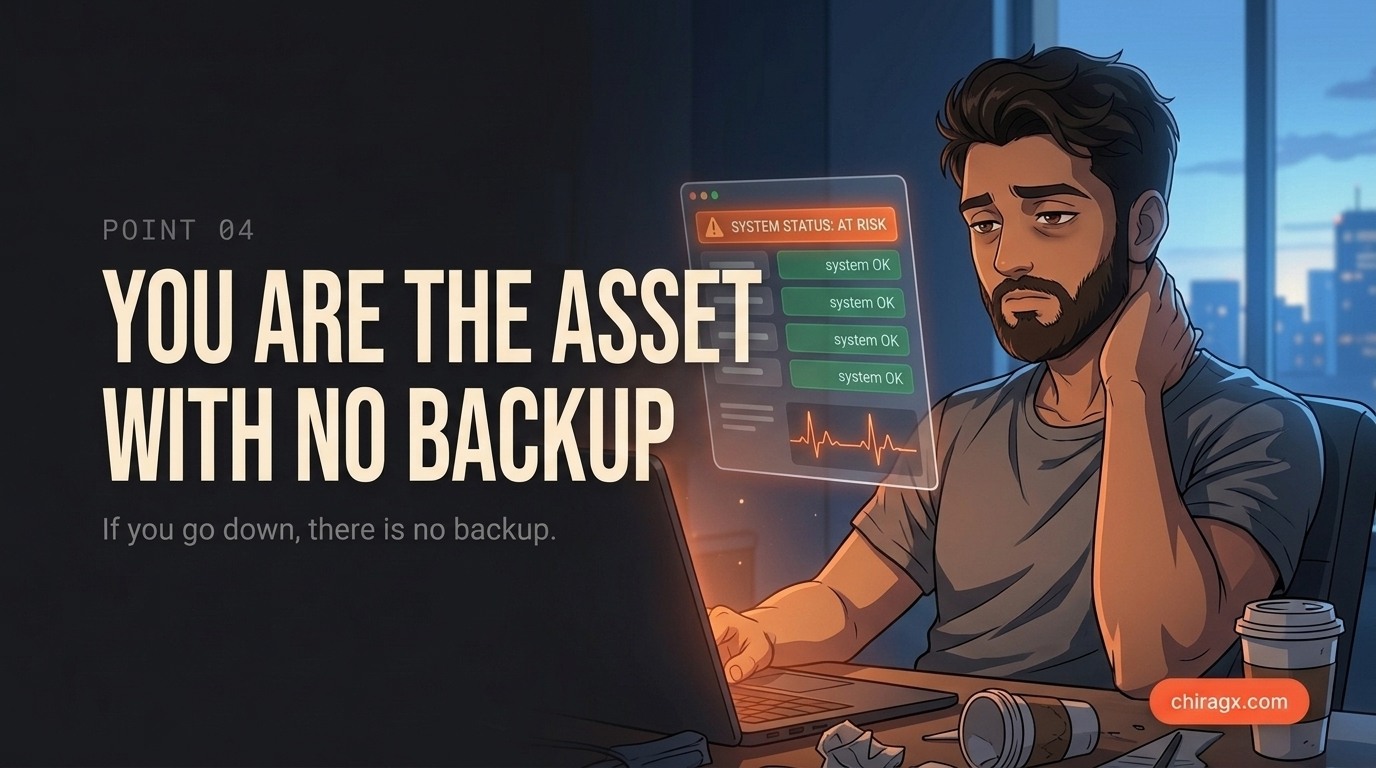
This is the hardest one to write, because I am still correcting it.
Last night I went to bed around one and got up at six. That is not an exception, it is the pattern of years. And for a long time I wore it like a medal, because this industry applauds whoever endures the most.
Over time I understood something uncomfortable: sleeping five hours does not make me more productive, it makes me recover more slowly. And here I want to be specific, because my case is particular: lack of sleep hits me biologically and physically, not mentally. Mentally I perform the same, and I still handle hard conversations well. But the body sends the bill even when the head does not feel it.
I train actively, and yes, that gives me more energy. But training does not cancel rest, it demands it: muscle grows when it recovers, and so do your organs. I can run my brain at a thousand percent and still be neglecting the one thing that has no spare part.
I run preventive maintenance on servers worth less than my health. That line sounds like self help, but it is pure business math: you are the asset with the least redundancy in your entire operation. If you go down, there is no backup.
I have not fully solved it. I am writing it precisely for that reason, because saying it out loud holds me to it.
5. I would have defined each partner's commitment before carrying it all
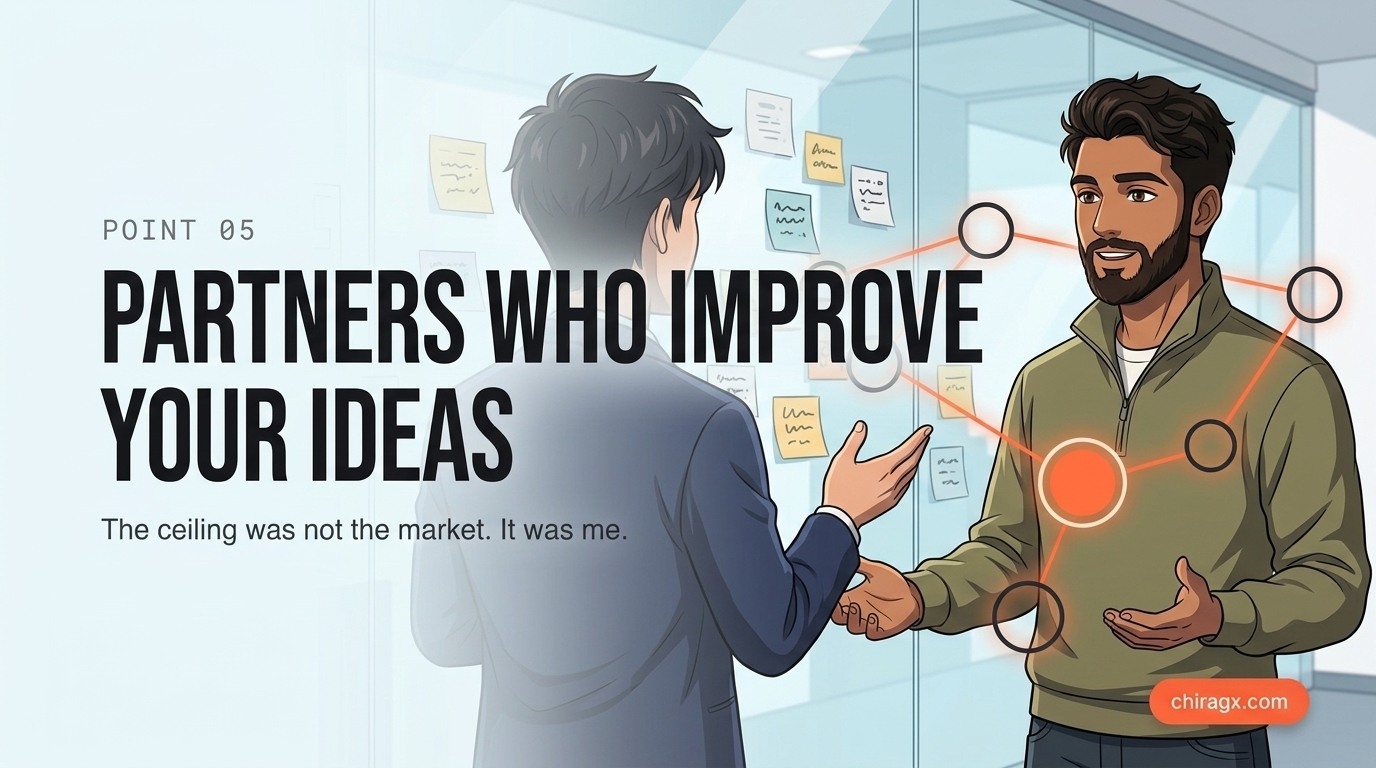
There is a romantic idea of the founder who does everything alone. I lived it, and I do not recommend it.
But before that, something more important: look for partners who resonate with the interests of the company before their own. In a partnership, the company has to be the common denominator of success. If the company wins, we all win. A hidden agenda contributes nothing: it overloads the people actually pushing the business, it blocks growth, and without clarity there is no fair way to measure who deserves what.
That is why today I would put in writing the rewards and the responsibilities of each partner, and also the consequence of not meeting them. Not out of distrust, but because clarity protects the relationship. Partners do not fight over what they agreed. They fight over what they never defined.
On doing it alone: it feels efficient, because nobody argues with you and you move fast. But a ceiling arrives, and the ceiling is not money or market: it is you. Your time, your blind spots, your mood on a Tuesday. Today artificial intelligence closes several of those gaps, and that is real. But it does not replace another person's creativity, or the hours a team saves you, or the value of hearing someone who sees the problem from a different angle. Keep learning, listen to podcasts, listen to your team, and then decide as the leader based on the problem you actually want to solve.
When I started building with partners and with people better than me at their thing, we did not just move faster. We moved toward better places, because someone else was reading the map.
If I started today, I would look sooner for the people who see what I cannot. Not employees to execute my ideas: partners who improve them.
On the first point I want to be specific, because it cost me and almost nobody says it: I built in silence. People did not watch me grow from zero. At some point I stopped publishing, and that sent a bill later. The problem is not only visibility, it is identification. When someone discovers you already built, they admire the result. When they saw you start from the bottom, they identify with you. And identification weighs far more than admiration, because people trust whoever resembles where they are standing today.
And on the second: I have served an enormous number of clients who, looking back, were a pure waste of time. I do not regret what I learned, but I do regret not defining sooner who I would not sell to.
6. I would have written down everything I learned

For years, the knowledge of my operations lived in one place: my head. How to quote, how to handle a difficult client, what to check before launching, why that project went wrong.
It felt normal. Until I wanted to grow and discovered I could not delegate anything, because nothing was written down. I had no SOPs, and no clear identity the people I hired could follow. Every new person had to learn from me in real time, and I was the bottleneck of my own company.
And here is the real cost, which took me a while to see: I do not usually repeat my own mistakes, but my team kept repeating mine, because I never left a record of them. That is how I ended up losing the same money twice: the first time because of me, the second because I never documented it for them. I had already walked that road and could have shortened it for them. Instead, I let them spend their time and energy discovering what I already knew.
Writing down what you learn is not bureaucracy. It is the difference between a company that depends on you and one that can run without you. And today artificial intelligence makes that work far faster: turning what is in my head into something someone else can follow is no longer a valid excuse. By the way, it is where almost everything I publish comes from: I do not invent content, I document what I already lived.
7. I would have started teaching much sooner

I sustain a completely free education community where thousands of people learn about technology and finance without paying a cent. It is one of the things I am proudest of. And my only regret is not starting it ten years earlier.
For a long time I thought teaching was something you do at the end, once you have arrived. That you needed permission, or credentials, or a certain level before you could speak.
False. Teaching is what accelerates everything else. It forces you to organize what you know, exposes you to questions you would never have asked yourself, and builds your reputation while you genuinely help. There is not a single thing in my career that has returned more than giving knowledge away.
And you do not need to be the best in the world. You only need to be two steps ahead of the person you are helping.
What I would tell the twenty year old Chirag
If I could send him a message, I would not tell him which business to start or what to invest in. I would tell him five things:
It will take longer than you think, especially if you do not use technology in your favor and you trust others blindly. And that is fine. Almost nobody arrives on the schedule they set at twenty.
Almost nothing that keeps you up at night will matter. What will matter is who you built with and how you treated people.
Train your body. The outside reflects the inside, and people do business with those who show discipline with themselves. Whoever takes care of themselves takes care of what is entrusted to them.
Talent is not the advantage. The advantage is continuing when nobody is watching and nobody is applauding yet.
Start telling what you know today. Not when you are ready. Ready never comes.
Why I am writing this today
Because I have spent fifteen years doing, and very little time telling. And lesson number one on this list is exactly that: what you do not tell does not exist.
If you are building something and you have spent years in silence waiting for the perfect moment to show it, this article is for you. The perfect moment is an elegant excuse for fear. I know because I used it for fifteen years.
None of this is theory. Every point cost me time, money or health. If it saves you even one of those three, it was worth writing.
And that judgment, looking at your operation honestly and fixing what is actually holding it back, is exactly what I have been preparing to teach in person, in a small hands-on group. If you want to be among the first to know when it opens, leave your details here (the workshop will be held in Spanish). And if you run a company and would rather solve it now instead of later, let's talk directly.

This is where I can help
Want to talk about your project?
Book an advisory call →Get every article in your inbox
AI and business analysis, no hype. Only when I publish something worth your time.